
Under Federal Rule of Evidence 901, the proponent of a recording must produce evidence sufficient to support a finding that the item is what it is claimed to be — a 1975 standard that synthetic media has converted from formality to fight, now that minutes of credible video and voice can be generated from seconds of source material. The bars and courtrooms of 2026 meet the consequence routinely: contested dashcam clips, "leaked" call recordings, and voice notes whose authenticity divides experts. Authentication is where those fights are won and lost before substance ever reaches a jury.
3G Times publishes information, not legal advice; evidentiary strategy belongs to trial counsel, and this analysis addresses the compliance-and-discovery reader.
What Rule 901 asks of a recording
The rule's illustrative list has long covered digital evidence: testimony from a witness with knowledge, comparison with authenticated specimens, distinctive characteristics including appearance and contents, and opinions of skilled examiners. For decades, a custodian's testimony that a file came from the system of record — plus visible continuity of the recording — carried routine clips through. That path assumed fabrication was expensive. Generative tools removed the assumption: the distinctiveness analysis now cuts both ways, because surface plausibility is precisely what synthesis produces best, and the courts' first deepfake-era skirmishes have been fought exactly there, in the gap between what a recording looks like and what its provenance can prove.
How has the authentication toolkit changed?
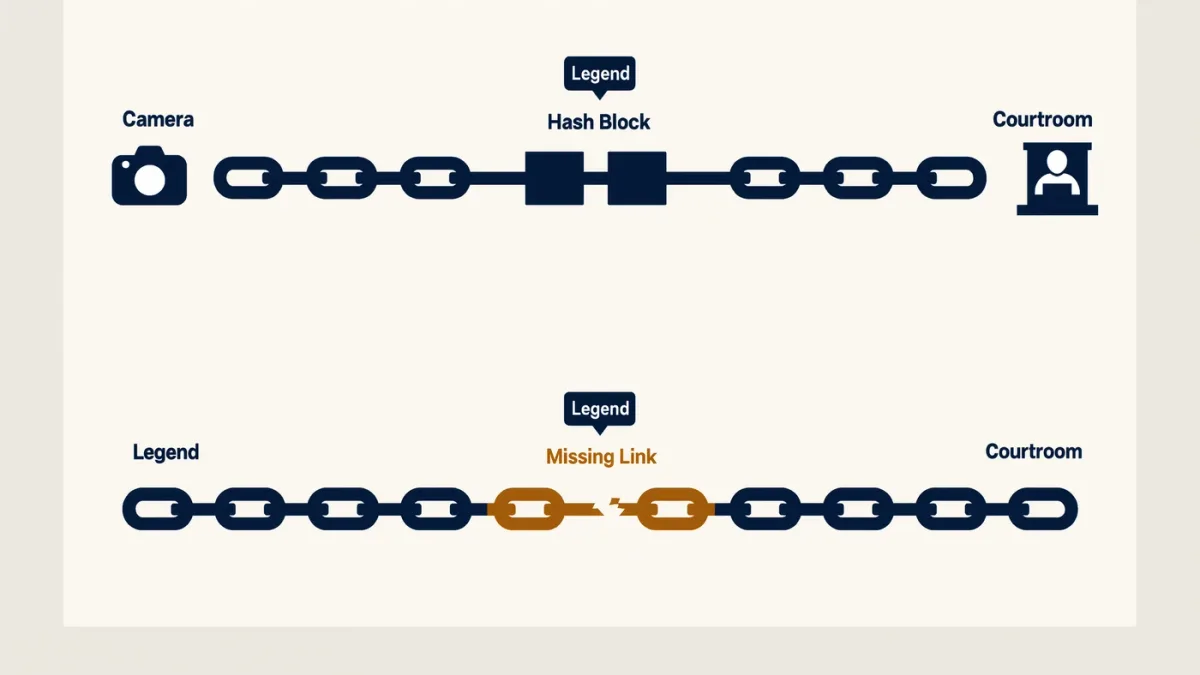
Three layers now do the work the old one did alone. Provenance records — capture-device metadata, hash chains, and the cryptographic provenance standards now embedded in flagship cameras and phones — travel with authentic media and break conspicuously when content is edited or synthesized. Forensic analysis looks where synthesis leaves artifacts: physical implausibilities in lighting and reflection, compression histories inconsistent with the claimed path, frame-level inconsistencies, and for voice, prosodic and channel signatures that cloning smooths over. Situational corroboration — the boring backbone — asks whether independent records, witnesses, and timing place the recorded event in the world. Each layer alone is arguable; together they are the showing Rule 901 requires.
| Authentication layer | What it evidences | Characteristic failure under synthesis |
|---|---|---|
| Capture provenance and hashes | Unbroken chain from device to exhibit | Missing or broken provenance on edited media |
| Forensic media analysis | Consistency of physical and signal properties | Lighting, reflections, compression anomalies |
| Corroboration | Independent placement of the event | No witness, record, or data trail matches the scene |
What does the defense side of the burden look like?
The evidentiary system's design assumes fabrication is rare enough that authentication can be light; the deepfake era makes the opposing party the system's correction mechanism. Defense practice has accordingly shifted from attacking relevance to attacking provenance: demanding the original device and its generation logs, deposing custodians on transfer history, and — where a recording lacks provenance entirely — asking the court to weigh its absence under Rule 901 rather than admit it through the lenient authentic-by-appearance route. Courts have responded unevenly, which is itself the practice point: the party that litigates authenticity early, with a documented forensic record, writes the standard the rest of the case inherits.
Why should a compliance reader care about trial evidence?
Because the same media arriving as evidence arrives as fraud: voice notes instructing payment, video of an executive authorizing a transfer, synthetic presence in onboarding sessions. The controls are shared. Retention of native formats with capture metadata is both a litigation posture and a fraud-forensics asset; provenance-standards adoption in corporate capture tools (meeting recording, bodycam, dashboard video) is a policy choice available now; and the incident-response plan that contemplates synthetic media — preservation of originals, designated forensic relationships, a decision path for public statements about contested authenticity — is cheaper to write before the first contested clip than after. Financial-sector investigations increasingly run the same authentication drills as courtrooms, months earlier.
What should a corporate media-evidence protocol say?
Institutions that handle recordings as part of investigations — fraud teams, HR, security operations — increasingly keep a one-page protocol that converts the courtroom discipline into intake practice. Native-format preservation comes first: the file as captured, with its metadata, quarantined before anyone opens it in a viewer that rewrites headers. Chain of custody follows — who touched it, when, with what tool — because authenticity arguments inherit procedural credibility. Forensic referral routes pre-defined: which lab, under what retainer, with what turnaround. And a privilege and disclosure path decided in advance, so the first contested clip does not force the legal, security, and communications teams to negotiate scope in real time. The protocol's last line is usually the most valuable: a rule that no synthetic-or-authentic conclusion is announced externally until the forensic layer has spoken, because public reversal costs more than silence.
The budget line follows the volume: authentication contests are no longer one-expert matters, and litigation budgets that carry a standing media-forensics estimate — rather than an emergency engagement — settle the question of how seriously to contest authenticity before emotions decide it.
Where does e-discovery carry the burden?
Discovery adds volume to the authentication problem. Collections now routinely include collaboration clips, screen recordings, and exported media whose provenance died at export, and the producing party's obligations run to what it has, not what it wishes it had. Preservation duties reach native formats — with metadata — from the moment litigation is anticipated, and spoliation doctrine grades the failure; a transcode-overwrites-native habit that was harmless in 2019 is now a sanctions-adjacent fact pattern. Teams that negotiate ESI protocols naming native-format production for contested media, hash-manifested, are front-loading the authentication fight into an agreement where it is cheapest to win.
What does this mean in practice?
- Preserve native files with metadata intact. Transcoding for convenience strips the provenance the authentication fight will need; retention policies should name native formats as the record copy.
- Adopt provenance-capable capture where offered. Camera and conferencing platforms with embedded provenance standards convert authenticity from argument to verification.
- Retain media-forensics relationships before disputes. The expert who has examined your ordinary recordings is the credible examiner of your contested one.
- Screen inbound media in fraud workflows. The payment-instruction voice note and the trial exhibit fail the same way — provenance first, appearance second.
The rules of evidence grade authenticity, not truth; they presume the parties will test what plausibility can no longer carry. The deepfake era is that presumption's invoice, arriving on every case with a screen.
Frequently asked questions
The synthesis-versus-detection race also prices the protocol: a standard written around last year's artifacts should schedule its own review, because both sides of the courtroom read the same quarterly releases.
Can detection tools reliably identify deepfakes?
Not as standalone proof. Detector performance moves with the generative state of the art, and results are probabilistic. In litigation practice they inform the forensic layer; the showing that persuades combines provenance, forensic analysis, and corroboration.
Who bears the burden when authenticity is contested?
The proponent under Rule 901, to a sufficiency-of-evidence standard — a low bar in theory that rises with what the opponent puts in dispute. The practical burden then lands on whichever party lacks the original device and its records.
Do the self-authentication rules help?
Rules 902(13) and 902(14) authenticate records generated by electronic processes and copies verified by hash — powerful for machine-generated logs, and precisely the mechanism to cite when opposing a recording that arrived without either.