
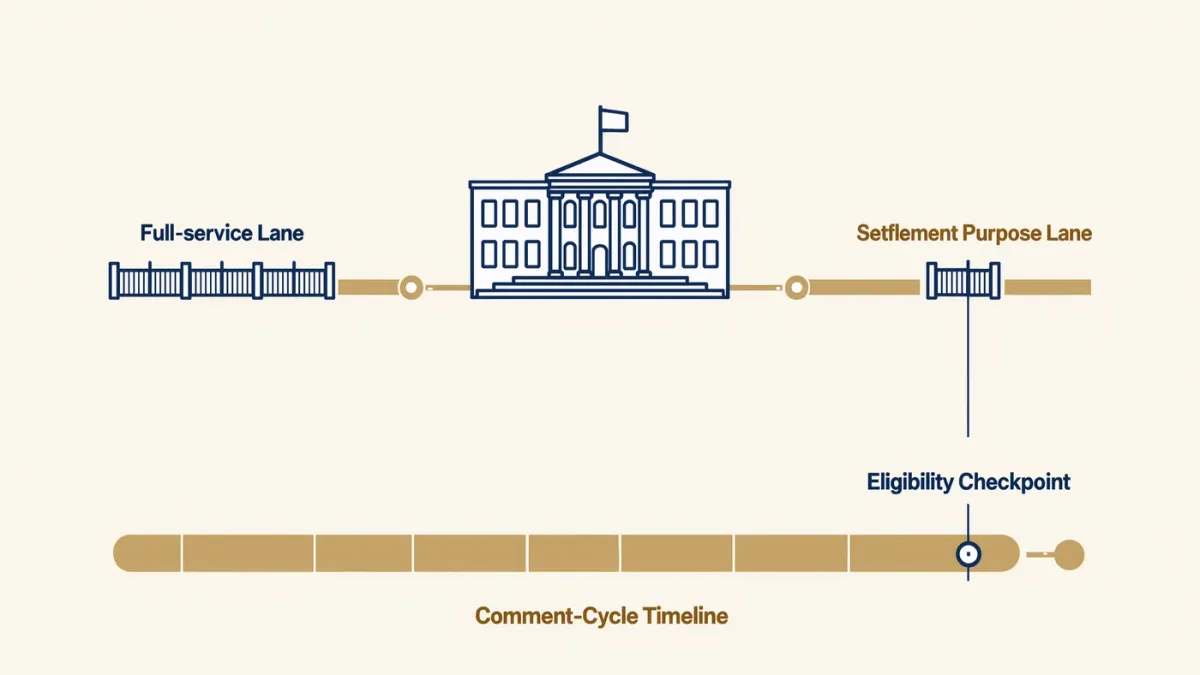
The Federal Reserve Board's May 20, 2026 proposal to establish a "payment account" — a special-purpose account through which legally eligible financial institutions, including fintechs, could access Federal Reserve Bank services for clearing and settlement specifically, positioned as distinct from and lower-risk than a full master account — completed its public-comment cycle with the industry's letters filed through July 2026, including a joint comment letter from The Clearing House association. The proposal arrived one day after the administration's fintech-integration executive order, and the pairing is the story: direct payment-system access for nonbank institutions is now official federal policy direction, moving from debate to docket.
3G Times publishes information, not legal advice. The proposal is a proposal: eligibility and obligations will be settled in the final rule, and access decisions remain case-by-case under the guidelines that govern them.
What does the proposal actually create?
A narrower door than a master account, deliberately. The payment account would carry the settlement function its name promises — participation in clearing and settlement through the Reserve Banks — with the Board's accompanying revisions to the Payment System Risk policy and the account-access guidelines (Federal Register, May 26, 2026) calibrated to what the Board frames as the account's limited risk profile: eligibility criteria, risk-management expectations, and the supervisory posture that accompanies direct access. The design inherits a decade of master-account controversy — the litigation and legislative attention that followed nonbank access requests after 2020 — and answers it with structure: a purpose-limited account whose risk controls are the price of admission, rather than the full-service relationship banks hold. For fintechs, the prize is settlement finality without nested banking; for banks, the question is what that does to the correspondent franchise built on being the only door.
The historical anchor matters for reading the risk lines: the master-account controversies after 2020 — litigation, denied applications, legislative hearings — are the precedent file both sides cite, which is why the proposal's risk-containment architecture reads as it does. The comment letters are arguing over whether structure settles what litigation once had to.
What did the comment letters fight over?
The public record through July shows three recurring lines. Eligibility strictness: where the legally-eligible line sits — which charters, what capital and liquidity floors, and whether state regimes qualify — with commenters split between welcoming breadth and urging bank-grade prerequisites. Risk containment: whether a purpose-limited account truly contains the risks direct access has historically raised — settlement-failure scenarios, supervision intensity, and the PSR policy's collateral and intraday frameworks as applied to novel institutions. Competitive structure: the banking-system letters, The Clearing House's prominent among them, press the systemic questions — payment-system integrity, the level playing field, and the supervisory resourcing that new direct participants would demand — while fintech-side and progressive comments press the access argument the executive order amplified. The comment file maps what the final rule must say.
The historical framing matters because the market has short memory: master-account access for nonbanks was the defining fintech-banking controversy of the early 2020s — fought in litigation, hearings, and individual dockets — and this proposal is that controversy's structural resolution attempt. Whatever the final rule says, the direction it represents was decided the day the Board voted to propose it: the door is a design question now, not a threshold question.
What should institutions do with a proposal at this stage?
- Model the settlement consequence. If the account arrives materially as proposed, payment-volume economics change for any institution currently paying a bank for the access — the model should exist before the final rule, not after.
- Read the eligibility draft against your charter. The criteria decide who the door is for; the gap analysis between the draft and the institution's current regulatory posture is the to-do list the final rule will price.
- Track the companion rulemakings together. The PSR revisions, the account-access guidelines, and the executive order's agency reviews are one package operationally — programs that sequence them separately will re-plan twice.
- Bank partners: renegotiate on the calendar. Correspondent pricing and service lines signed in 2026 should contemplate the world where the fintech's next renewal conversation happens with a Reserve Bank in the room.
A comment cycle is not a law; it is the industry showing its arithmetic. The arithmetic on display in July 2026 says the payment perimeter is opening by design — purpose-limited, risk-conditioned, but opening — and the institutions that treated the docket as a planning input rather than a spectator sport will be first through whatever door the final rule sets.