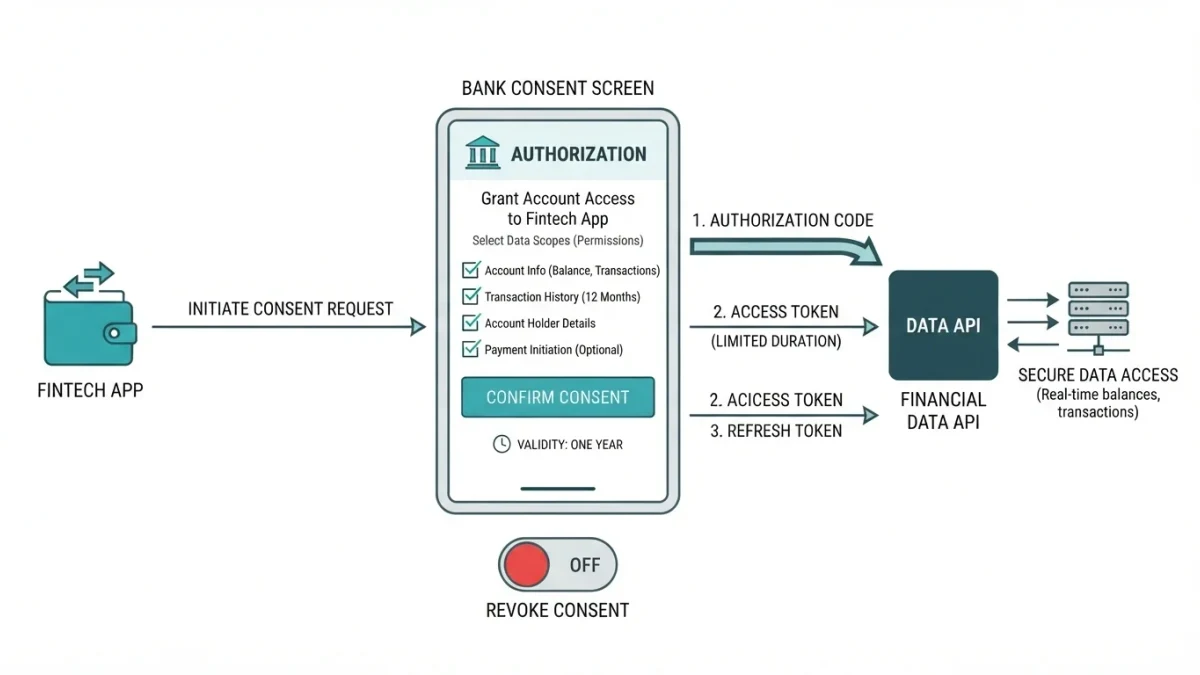

A consent receipt is a structured record of what a consumer authorized: which data, to whom, for what purpose, on what date, for how long, and under what revocation terms — a concept the privacy-engineering community standardized years ago and that open-banking regimes have now made load-bearing. The EU's framework treats payment-account consents as time-boxed, revocable instruments with maximum durations; the CFPB's Section 1033 rulemaking — adopted in late 2024, its compliance timeline contested and revised since — built revocation and authorization-scope duties into its data-access architecture. The pattern across regimes is identical: consent became a transaction with a lifecycle, and the program that cannot evidence the lifecycle cannot defend the data flows built on it.
3G Times publishes information, not legal advice. Consent architecture interacts with each regime's authorization rules and belongs with counsel in the applicable jurisdictions.
What should a consent record contain?
The receipt's fields answer the questions an examiner, a court, or an aggrieved customer will ask in order. Identity: who consented, authenticated how, on which device. Scope: which accounts and data categories, named — not "financial data" but the actual permission set. Counterparty: the authorized recipient, identified precisely enough that a revoked consent unambiguously binds them. Purpose: the stated use, because purpose limitation is enforced against the record. Temporal bounds: granted when, effective when, expiring when — with the regime's maximum-durations respected. Terms presented: the version of the disclosure the consumer actually saw. Lifecycle events: amendments, renewals, revocations, each with its own timestamp and evidence. And integrity: a hash or signature chain making the record tamper-evident, because a contestable receipt is an exhibit that argues with itself.
| Field | Question it answers | Failure mode without it |
|---|---|---|
| Scope (accounts, categories) | What was shared? | Over-collection invisible |
| Counterparty identity | With whom? | Revocation misses recipients |
| Purpose | Why? | Purpose-limitation unenforceable |
| Terms version | Told what? | Notice disputes unresolved |
| Lifecycle events | Changed/revoked when? | Zombie consents |
| Integrity chain | Can it be trusted? | Record contestable at audit |
Why is revocation the hard half?
Because a right to revoke is operational, not declaratory. The consumer's revocation must propagate: the aggregator stops pulling, the cached data meets its deletion clock, downstream sub-processors receive the stop, and the deletion (or de-identification) is evidenced. The classic failure is the consent that dies at the app but lives in the pipes — the revocation recorded in the customer-facing system while collection continues on a separate integration, or the cached-data retention that never had a stop condition tied to consent state. The receipt architecture treats revocation as a first-class event with its own propagation log: who stopped, when, what was deleted, with confirmations. Programs that rehearse the propagation path — table-top the full revoke-to-deletion chain — discover in the exercise the integration nobody remembered; programs that skip the rehearsal discover it in a supervisory finding.
How does the receipt become exam evidence?
Through the same discipline that turns any operational log into an audit artifact: completeness, retrieval, and reconciliation. Completeness — every data-sharing flow with a legal-consent basis lands in the same store, including partner and sub-processor flows, because the exam population is "all consents," not "the ones the consent service saw." Retrieval — produce by consumer, by counterparty, by date, in minutes, with the presented-terms version attached; the two-week retrieval is a finding wearing a loading spinner. Reconciliation — periodic sampling that proves active collections trace to active, in-scope consents, with exceptions measured and remediated; the metric "collections without live consent" trending at zero is the number that ends the exam's line of questioning. Data-access regimes make this arithmetic explicit: authorized requests must stand on current authorization, and the institution that cannot join its traffic to its receipts answers with anecdote.
How do aggregators and fintechs split the duty?
By contract that mirrors the architecture. The consumer-facing institution owns the receipt for consents it captured; the collecting party owns propagation of revocations it receives; sub-processors owe confirmations up the chain. The clauses that matter name the interfaces — the revocation endpoint that must work, the deletion SLA that must run, the audit-log export each party owes the other — and the liability follows the record: the party that cannot evidence its leg of the lifecycle holds that leg's exposure. Partner-bank diligence in open-banking programs reads these clauses the way card programs read network rules, which is the signal that the market has already standardized around receipts as infrastructure.
What does this mean in practice?
- One store for every consent basis. App flows, partner flows, and sub-processor chains in the same ledger — the exam population defined by architecture, not by which team was asked.
- Version the presented terms. The disclosure the consumer saw is part of the receipt; without it, "informed" is an adjective, not evidence.
- Rehearse revocation end-to-end. The forgotten integration is found in the exercise or in the finding — the same choice every table-top offers.
- Report the reconciliation number. Collections-without-consent, sampled and trended, is the metric that converts consent from legal posture to managed control.
Open banking's promise to consumers was control — granular, revocable, time-boxed. The receipt is that promise in machine-readable form, and the audit trail is its proof. Institutions that built both as one artifact answer the era's defining question — "show me the authorization" — with a query; the others answer it with a project.
A standards note anchors the field vocabulary: receipt formats circulating in the privacy-engineering and open-banking communities converge on the same core fields — scope, counterparty, purpose, duration, lifecycle events — so the schema choice is less important than the completeness discipline. Programs that adopted a published format report the same benefit the SBOM world found: auditors and partners recognize the shape before reading the contents.
How do receipts handle intermediaries?
By naming them: the receipt that lists only the consumer-facing app while an aggregator and two sub-processors touch the data answers the examiner's second question with silence. The scope field should carry the full delivery chain at grant time, and the lifecycle events should follow it — the reconciliation that cannot see intermediaries cannot reconcile them.
Frequently asked questions
Are consent receipts legally required?
Not as a named artifact in most regimes — the duties are to obtain, honor, and evidence authorization, and the receipt is the standardized way to do all three. Regimes that specify revocation and scope duties effectively require the receipt's contents, whatever the implementation calls them.
How long should receipts be retained?
Beyond the consent's own life: long enough to answer disputes and exams about every collection made under the consent, which in practice ties retention to the data-governance schedule for the shared data itself rather than to the session that granted it.
The dashboard pattern completes the consumer side: a self-service view of live consents — scope, counterparty, expiry, revoke button — converts the receipt architecture from a back-office ledger into the control the marketing copy promised. Programs report that the dashboard's revocation telemetry is also the early-warning system for UX friction masquerading as consent abuse.
Do receipts apply outside open banking?
Wherever consumer authorization precedes data sharing — marketing consents under ePrivacy-lineage rules, sensitive-data permissions under state statutes, research enrollments. The structure is general; open banking is merely the regime that industrialized it.