Zero-knowledge proofs let one party demonstrate that a statement is true without revealing anything else — over-18 without birth date, sanctions-clean without identity, funded-account status without balance — and in KYC they promise the selective-disclosure architecture that privacy law demands and document-upload onboarding cannot deliver. The supervisory question runs on a different track: customer-identification and recordkeeping regimes ask regulated institutions to show the evidence, and the industry's 2026 state is a working answer where the proof's verifiability, not the underlying data's visibility, constitutes the audit artifact.
3G Times publishes information, not legal advice; the acceptability of any verification technology is an institution-and-regulator question under each regime's CDD rules.
What does the technology actually prove?
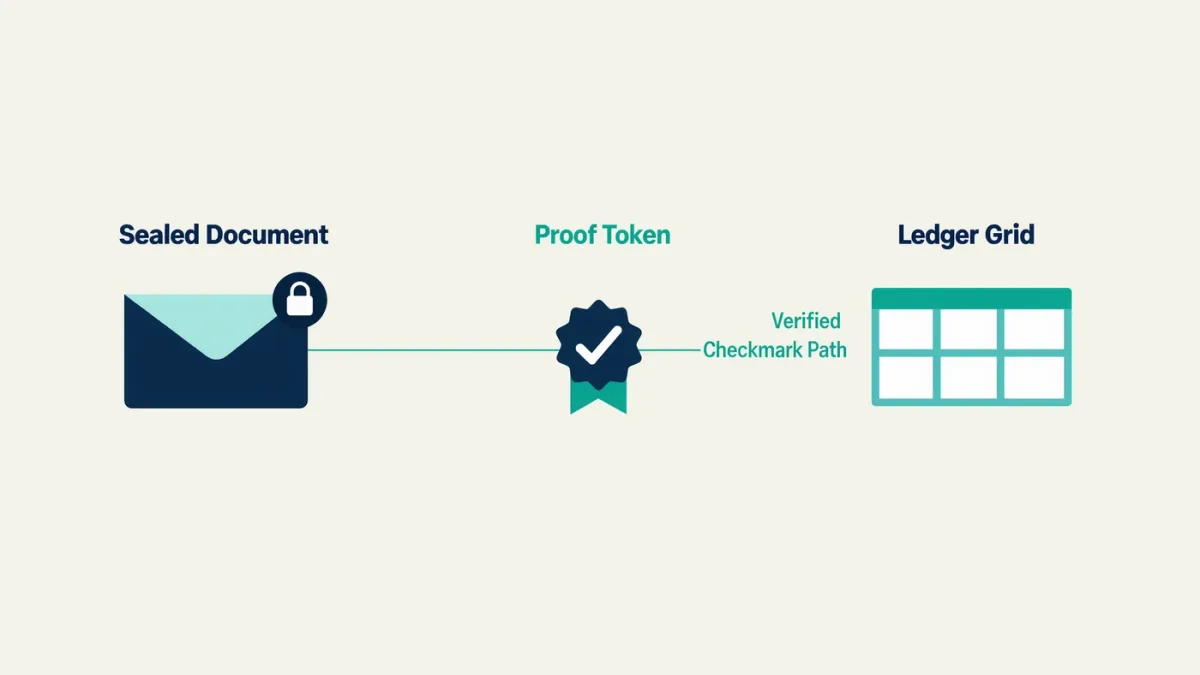
A zero-knowledge proof system binds a claim to an issuer's credential without exposing the credential. In the KYC pattern: a licensed verifier confirms a customer's identity once; a wallet holds the resulting attestation; when a fintech needs "identity verified at level X by licensed verifier Y on date Z," the wallet generates a proof that the attestation says so, cryptographically checked against the issuer's public key. The relying party learns the fact and the issuer's authority, not the document. Revocation is handled by the issuer publishing accumulators or the proof embedding non-revocation evidence with freshness constraints. None of this is exotic mathematics anymore — the building blocks ship in mainstream identity libraries — and the eIDAS 2.0 wallet framework's selective-disclosure features sit adjacent to, and interoperable with, the same machinery.
What does an AML regime require that seems to conflict?
The apparent conflict: BSA-style regimes tell institutions to collect identity information, retain records, and produce them on request; ZKP-flavored flows collect proofs instead of information. The reconciliation runs through what the institution is actually asked to hold. Customer identification requires specified data elements at onboarding; beneficial-ownership rules reach entities; ongoing monitoring reaches risk. A compliant ZKP architecture is layered honestly: identity data is verified once by a regulated verifier that holds the record under its own regime; the institution retains the proof, the verification result, the issuer's identity, and the timestamp — which is precisely the audit evidence FATF's digital-identity guidance contemplates when it accepts reliable digital ID for CDD elements. What the institution cannot do is prove compliance with a system whose verifier is unregulated, unrecorded, or unauditable — the proof proves the fact, but the examiner audits the chain.
What does the audit evidence look like?
The exam-ready package for a proof-based flow has four layers. The issuer dossier: who verified, under what license, with what controls — the same due diligence a bank applies to any outsourced CDD element. The proof record: for each onboarding, the statement proven, the issuer key, the verification result, and the timestamp, stored with the CDD file. The freshness mechanism: how revocation is checked and how stale proofs are refused — the examiner's first fraud question. The fallback path: what happens when a proof cannot be generated or verified — the full-data path that keeps exclusion from becoming the control. Institutions that present these four layers describe exams that proceed like any other digital-ID review; the ones that present a whitepaper instead of a dossier have the finding appointment already made.
| Evidence layer | What it demonstrates | Without it |
|---|---|---|
| Issuer dossier | Regulated, audited source of the credential | Proof of unknown provenance |
| Proof record | What was proven, by whom, when | Onboarding without a file |
| Freshness/revocation design | Stale and revoked states handled | First fraud incident unanswerable |
| Fallback path | Inclusion via full-data route | Exclusion risk and complaints |
Where has acceptance actually moved?
Three anchors. FATF's digital-identity guidance, since 2020, treats reliable digital ID as capable of satisfying CDD elements — technology-neutral on the cryptography, specific on assurance and auditability. The EU's eIDAS 2.0 framework normalizes government-issued selective disclosure at qualified assurance, which puts the issuer-dossier layer under statute. And the travel-rule and sanctions-screening world has absorbed the adjacent lesson at scale: what matters to supervisors is the verifiable chain — who attested, what algorithm, what timestamp, what revocation state — not whether a human saw a passport. What has not happened, and honest vendors say so, is a supervisory blessing for "pure" ZKP replacing regulated verification; the accepted pattern is proof over regulated verification, which is the layering above.
The vendor landscape rewards a specific skepticism: "zero-knowledge" appears in marketing for systems that merely hash or token-ize, and the difference matters at exam time. A true ZKP binding verifies against an issuer key without the underlying data anywhere in the flow; anything that can reverse to the document is selective disclosure, not zero knowledge — still useful, differently evidenced, and honestly labeled only by its architecture documentation.
What are the honest limits?
Proofs verify statements; regimes also demand updates — a sanctions state can change between proof and transaction, so screening remains a separate, non-ZKP layer operating on watchlists, not on credentials. Beneficial ownership for entities has no widely-adopted credential infrastructure, so the wallet story is natural-person-first. And the privacy that motivates the technology cuts against the institution's own fraud analytics: a file of proofs is thin training data for the risk models that follow onboarding, which is why production architectures keep an audit-only data plane distinct from the selective-disclosure plane. The technology earns its place per use case — age and eligibility gates, re-verification, portability between group entities — rather than as a slogan.
What does this mean in practice?
- Diligence the issuer like a vendor, because it is one. License, controls, audit rights, and termination path — the dossier precedes any production proof.
- Store the proof record as CDD evidence. Retention clocks match the relationship, not the session; the examiner's request will be years later.
- Demonstrate freshness under adversarial questions. The revocation design is the part of the architecture that fails first in exams and in fraud.
- Scope to where proofs beat documents. Portability and re-verification are the early wins; screening and entity ownership are not yet proof problems.
The regulatory conversation about zero-knowledge KYC has matured past novelty: supervisors are not asking whether the mathematics works — they are asking for the file that shows whose signature stands behind it. Institutions that kept the regulated verifier in the loop and the proof records in the CDD cabinet have found the technology adoptable, one gate at a time.
Do zero-knowledge proofs help with data minimization duties?
Directly — the same mechanism that satisfies examiners produces the minimal disclosure privacy regimes reward. A proof that answers one eligibility question discloses one fact; the data-minimization analysis and the audit analysis land on the same design, which is the technology's real compliance argument.
Frequently asked questions
Can a zero-knowledge proof replace ID document collection?
For specified CDD elements, yes, where the proof binds to a regulated verifier's attestation and the record of that verification is retained — the pattern FATF digital-ID guidance and eIDAS-adjacent frameworks accept. Entity ownership and screening remain separate duties.
Do examiners accept cryptographic evidence?
They accept verifiable chains: issuer identity, verification result, timestamp, revocation state. The cryptography is the transport; the dossier behind it is the evidence.
What is the biggest implementation risk?
Issuer diligence. A proof system's assurance is capped by the verifier behind it — unregulated issuance converts elegant cryptography into an unauditable dependency.