
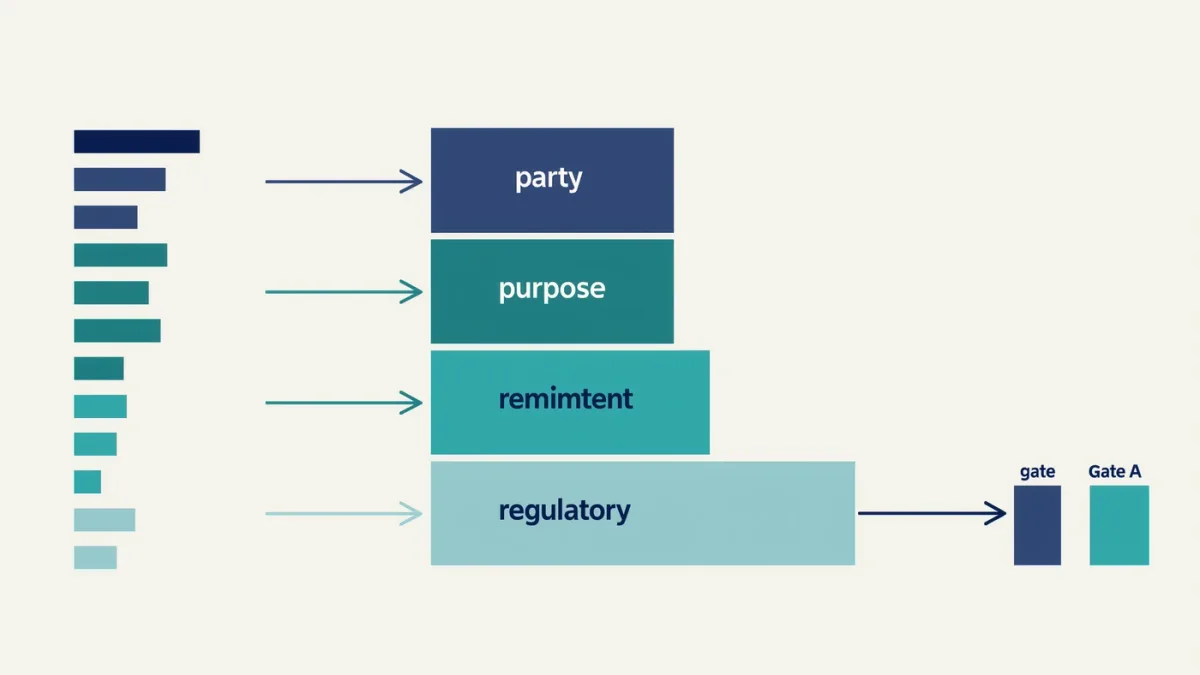
The Federal Reserve completed the Fedwire Funds Service migration to ISO 20022 on March 10, 2025, joining CHIPS and the newer instant rails on the structured-message standard — which means the dominant US payment messages now carry machine-readable purpose codes, structured remittance data, party identification fields, and regulatory-reporting elements that the flat legacy formats physically could not. For compliance, the migration is not an IT milestone but a data event: screening, monitoring, and travel-rule programs built on sparse fields are now under-utilizing richer inputs their controls could be reading.
3G Times publishes information, not legal advice. Payment-system participation and screening decisions are institution-specific and belong with the applicable operator rules and counsel.
What does the richer message actually contain?
An ISO 20022 credit transfer expresses what the legacy format compressed into free-text: an explicit purpose code drawn from a controlled vocabulary; structured party data — originator and beneficiary names, addresses, account identifiers, and organization identifiers; remittance information broken into references, amounts, and invoice-level detail; and regulatory-reporting fields designed to carry exactly what authorities ask. The standard's premise is that payment data becomes computable: a purpose code is a value a screening engine can branch on, while "PAYMENT FOR SERVICES" is a string a human once read. The caveats are equally structural — field population is only as disciplined as the sending institution, and free-text fields survive for senders who fill them, so parsing strategies must treat structured fields as the primary signal and text as the residue.
What can compliance do with the new data?
Three programs read the migration directly. Sanctions screening: party fields with dedicated name-and-address structures, organization identifiers, and clearer beneficiary chains reduce false positives and improve true-match triage — the screening engine stops parsing prose and starts reading addresses as addresses. AML transaction monitoring: purpose codes and structured remittance data sharpen typology rules — payments whose stated purpose, counterparty, and amounts reconcile less require less human review, concentrating analyst effort where the data itself signals inconsistency. Travel-rule and recordkeeping duties: the originator and beneficiary fields align with the transmittal-information packets the BSA travel rule expects, which is why IVMS-style crypto messaging and ISO 20022 wire data converge on similar shapes — the regimes were always asking for the same facts; the formats have finally caught up.
| Message element | Legacy reality | ISO 20022 upgrade | Compliance use |
|---|---|---|---|
| Purpose | Free text, if present | Controlled purpose code | Typology rules, licensing checks |
| Party identification | Name and account, unstructured | Structured name, address, identifiers | Screening precision, deduplication |
| Remittance | Opaque text lines | Structured references and amounts | Investigation reconstruction |
| Regulatory data | Outside the message | Reporting-purpose fields | Authority-required transmission |
Why has adoption inside compliance lagged?
Because the message standard changed before the control estates did. Screening and monitoring platforms were architected around legacy field maps; consuming structured data well means re-tuning rules, re-validating thresholds, and retraining analysts who were taught to read prose — work with project cost and model-risk governance attached. The lag is also rational sequencing: institutions prioritized payment-operations continuity through the cutover window, with compliance uplift following. The risk is that "following" becomes "never" — a monitoring estate blind to purpose codes in 2026 is increasingly a question examiners know to ask, because the data is not proprietary; it is on the wire every day, and the institution's own messages answer whether the controls read it.
How should programs sequence the uplift?
Inventory first: which payment streams now arrive in ISO 20022, which platforms consume them, which rules reference structured fields. Then a measured recast: purpose-code-aware rules introduced in shadow mode against the legacy-tuned production rules, with divergence analyzed before cutover — the model-risk discipline SR 11-7-lineage programs already run for any scoring change. Data-quality monitoring runs throughout: field-population rates by counterparty, purpose-code validity, free-text residue — because the structured era's honesty metric is how often senders leave the structure empty. And the investigator experience deserves deliberate design: case files that surface the structured fields first read faster and document better than ones that still lead with prose.
What does this mean in practice?
- Audit the field maps. Confirm which ISO elements each screening and monitoring platform actually consumes; the gap list is the roadmap.
- Recast rules in shadow mode. Structured-data rules earn their switch-on with measured divergence, not enthusiasm.
- Monitor sender discipline. Population rates by corridor and counterparty tell you where the data is real and where it is ceremony.
- Align crypto and fiat packet design. Travel-rule payloads and ISO party structures converge; one data dictionary serves both regimes and simplifies reconciliation.
The migration's quiet promise is that compliance stops reading payments the way humans read memos. The institutions that finish the reading — rules recast, fields consumed, quality measured — will hold the same rails as everyone else and know more about what crosses them.
Correspondent chains add the multiplier: structured fidelity degrades across borders where format conversion reintroduces free text, so corridor-level population monitoring belongs in the data-quality dashboard — the same field that arrives coded from a direct sender may arrive as prose after two intermediary conversions, and the screening estate must price both realities.
How does this interact with instant payments?
Rails like FedNow and RTP were born on ISO-lineage message structures, so the structured-data disciplines — purpose awareness, party-field screening, quality monitoring — are the same disciplines with higher stakes: screening happens in-session, and false positives cost settlement rather than patience. The wire-migration uplift is therefore rehearsal for the instant rails every institution is being pushed toward.
One closing alignment note: because the party fields now carry structured identifiers, they also feed counterparty-risk and concentration analyses that previously required separate feeds — the payment message quietly became a data source for programs that never asked it to be, and the data-governance file should acknowledge the expanded read before an analyst does.
Who should own the field-map audit internally?
Financial crimes compliance owns the question and technology owns the answer: the audit itself is a joint artifact listing, per payment platform, which ISO elements are consumed where. Ownership matters because the document decays — every screening upgrade and rule change silently edits it — so the operating pattern couples it to change management the way model inventories couple to model changes.
Frequently asked questions
Did all US rails move to ISO 20022?
The major wires did — Fedwire completed March 2025, CHIPS before it, and instant rails were born on the standard. ACH remains in its native format with its own modernization path, so screening estates still bridge formats by design.
The examiner's version of the question is already written: "show how your screening consumes structured fields and how you measure sender population rates." An institution with the field-map audit and the quality dashboard answers in one meeting; an institution without them schedules the second meeting that findings come from.
Do purpose codes replace analyst review?
No — they prioritize it. A code is the sender's characterization, unverifiable on its face; its value is in triage and consistency, with investigation unchanged where risk concentrates.
The documentation angle completes it: investigations supported by structured fields reconstruct faster and read better to requesting authorities, because the case file cites machine-readable facts rather than interpreted prose. The uplift's ROI shows up in query-response hours before it shows anywhere else.
What is the fastest defensible uplift for a small institution?
Consume the structured party fields in screening — the false-positive reduction is immediate and measurable — then phase purpose-code rules through the same model-governance path as any threshold change.