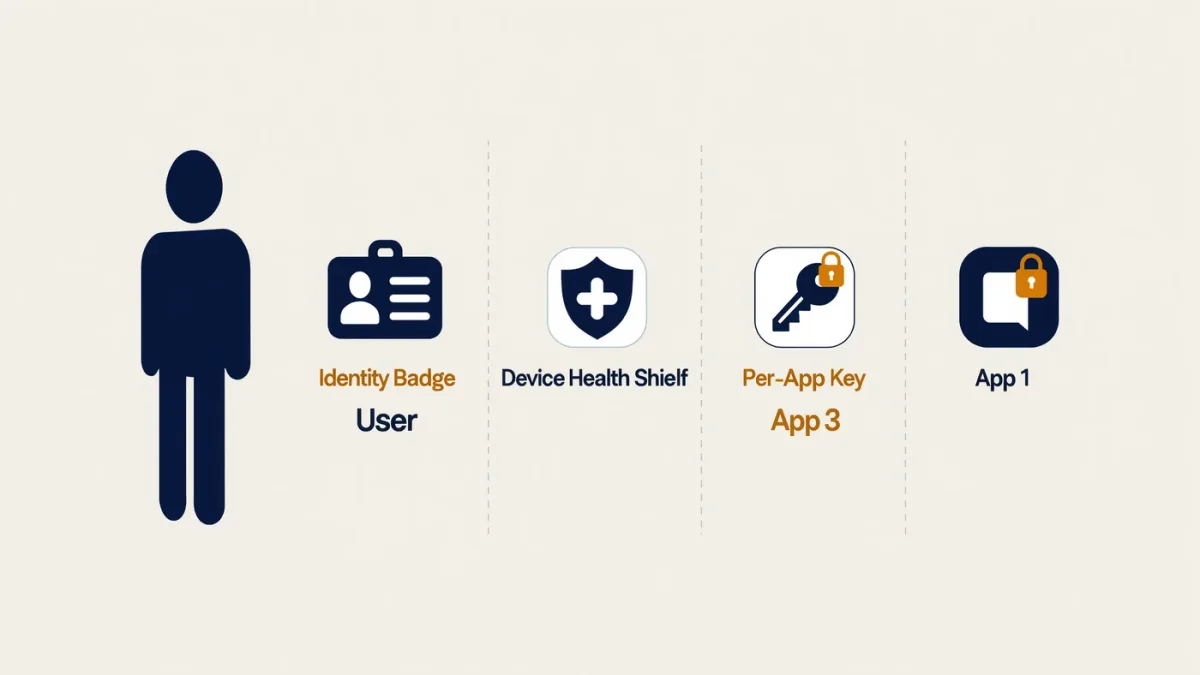

NIST Special Publication 800-207 (February 2020) defined zero trust as security architecture without implicit trust: every access request is evaluated per session against identity, device posture, and context, with policy as the runtime judge — a model the federal government mandated for its own agencies through OMB memorandum M-22-09, and that financial institutions have absorbed through FFIEC-lineage guidance and vendor defaults. The legal layer arrives with the granularity: an architecture that decides, records, and constrains who saw which customer data field and when is simultaneously a security control, an evidence machine, and a workplace-surveillance system with duties attached.
3G Times publishes information, not legal advice; monitoring law is jurisdiction-specific, and programs need counsel's mapping before dashboards ship.
What does zero trust change, structurally?
Perimeter security granted access by network location: inside the wall, broad reach. Zero trust removes the wall's meaning. Access is per-resource and per-session, evaluated continuously; device health, authentication strength, and behavioral signals gate each request. The security argument is orthodoxy by now — lateral movement dies without implicit trust. For regulated data, the architecture's value is more specific: least privilege becomes technically enforceable at the field level, data flows become observable by construction, and the policy engine's logs record an access history no perimeter regime ever produced. Those three properties map directly onto supervisory asks — need-to-know, data mapping, and auditability — which is why examiners have stopped asking whether zero trust and started asking how it is governed.
Where are the legal pressure points?
First, monitoring and employee privacy. Continuous verification collects behavioral signal: when, from where, how anomalously. In the US, employment notice and consent practices plus state laws on employee monitoring frame the analysis; in the EU, GDPR's employment-purpose balancing and works-council consultation in several member states make the monitoring design a documented decision, not a toggle. The compliant pattern publishes the data map: what signals are collected, for what security purpose, with what retention, and never repurposed for performance management — repurposing is where programs acquire labor-law exposure on top of privacy exposure.
Second, purpose limitation meets risk analytics. Fraud and security telemetry flowing into shared analytics platforms drag customer data with it; the zero trust log is customer data under GLBA, GDPR, and state regimes alike. The architecture should tag telemetry's permitted uses at capture, because downstream models cannot unsee what they trained on.
Third, the policy engine is itself a decision system. Access denials affect employees and, where customer-facing flows depend on the same engine, customers. Denial logic should be explainable to the person denied and reviewable by a human — the Article 22 instinct applied to infrastructure, and in unionized or works-council contexts, a negotiated matter.
| Zero trust property | Security value | Legal counterpart |
|---|---|---|
| Least privilege per field | Blast-radius control | Need-to-know in GLBA/state regimes |
| Full access logging | Forensics | Audit evidence; also surveillance data |
| Continuous device posture | Compromised-device containment | Employee monitoring notice duties |
| Policy-as-code | Consistency, velocity | Governance artifact; change-management record |
How should the policy engine be governed?
Policy-as-code converts access rules into versioned artifacts, and the governance moves with it: changes reviewed by security and the data owner, privacy review where rules touch telemetry reuse, and a segregation between the engineers who write policy and the administrators who could weaken it. The examination story writes itself from the artifacts — policy repository history, approval trail, exception register with expiry dates. The failure pattern is equally predictable: a policy engine governed as infrastructure (ops-only change control) drifts from the data governance it enforces, and the first access incident becomes a discovery exercise into who authorized what, answered badly.
How does zero trust interact with third-party access?
Vendor access is the regime's proving ground. Perimeter-era vendor VPNs granted networks; zero trust grants sessions to named resources, time-boxed and recorded — a strict improvement for the third-party risk file, and one regulators' guidance now assumes. Contracts should speak the architecture's language: named-credential access, no shared accounts, session logging delivered on request, and access revocation as a termination-path step rather than a negotiation. For fintechs selling into banks, supporting customer-managed, least-privilege admin access has become a diligence differentiator precisely because the buyer's zero trust file needs the vendor to close the loop.
What does this mean in practice?
- Publish the monitoring data map. Signals collected, purpose, retention, and the no-repurposing rule — internally and, where required, in employment notices.
- Tag telemetry for permitted use at capture. The security log that never meets a fraud model is cheap; the one that silently did is a finding.
- Govern policy like a control document. Versioned, approved, exceptioned with expiry — the exam artifact and the incident artifact are the same file.
- Close the vendor loop contractually. Named sessions, delivered logs, revocation on termination — architecture the contract can reference rather than restate.
Zero trust's promise to legal and compliance is precise: the architecture that enforces least privilege also produces the evidence that least privilege was enforced. The programs that harvest both treat the policy engine as governance — and the ones that treat it as plumbing spend their incident budgets discovering their own rules.
One integration completes the loop: routing the access log's exception events — anomalous field-level reads, after-hours privilege escalations — into the same triage queue as fraud alerts. Most programs keep these apart, and the separation costs exactly the correlation that turns a security event into a customer-data incident determination. Joined, the two streams answer the notification question at the speed the clocks demand.
How does this change breach notification readiness?
Field-level logs answer the hardest notification question — whose data, which elements, how accessed — in query time instead of investigation time. The zero trust log is the classification input; the programs that wired it into their state-law mapping deliver notices faster and defensibly, which is also what regulators measure after the fact.
A last word on evidence hygiene: the access log's own retention needs governing like the data it describes — unbounded telemetry is its own privacy finding, and bounded telemetry with stated purpose is both defensible and cheaper to store. The data map ends by mapping itself.
Where do most programs start?
With identity and the crown-jewel data map: strong authentication for everyone, then least-privilege rules over the systems holding regulated data, then telemetry reuse and vendor access in the second wave. The sequencing matters legally as well as operationally — each stage produces its own governance artifacts, and boards read progress in the artifacts, not the architecture diagram.
Frequently asked questions
Is zero trust required for financial institutions?
No regulation names it. The requirements arrive functionally — least privilege, data mapping, monitoring, and vendor access control — and zero trust is the dominant architecture for meeting them; examiners ask about the functions, not the trademark.
Do zero trust logs count as customer data?
Where they identify customers and their data access, yes — treat them under the same GLBA/GDPR/state ret impositions as the systems they record. Retention and permitted-use decisions belong in the data map.
How does this interact with remote work?
Zero trust is what made broad remote work defensible: posture-checked, per-session access replaced the perimeter that remote erased. The legal residue is the monitoring notice — the same signals that defend the remote session describe the employee's day.